Progressive House Energy Flow: Building a 90-Minute Arc

Progressive House Energy Flow: How to Build a 90-Minute DJ Set
How do you build a progressive house DJ set? How should you structure the energy curve of a 90-minute progressive house set? The answer usually has less to do with BPM and more to do with controlling intensity, arrangement, harmonic compatibility, and track sequencing.
Progressive house is one of the genres that rewards patience and long-form DJing. That is also what makes it difficult to prepare well.
Most progressive house tracks sit within a relatively narrow 120-126 BPM range. That means BPM alone provides very little information about where a track belongs in a 90-minute set.
A strong 90-minute progressive house DJ set is not simply a playlist of great tracks. It is a carefully shaped journey with a controlled energy curve, deliberate harmonic transitions, and enough contrast to make the peak actually feel like a peak.
This guide explains how progressive house energy flow works, how to structure a 90-minute set, why BPM is not enough, and how tools such as MixPilotLab can make the preparation process faster.
Why Energy Curves Matter So Much in Progressive House
One of the defining characteristics of progressive house is its relatively narrow tempo range.
A 122 BPM track and another 122 BPM track can feel completely different in intensity.
Consider two tracks:
- A sparse progressive house track with filtered drums and long atmospheric pads
- A dense peak-time track with heavy kick, bass, percussion, and layered synths
Both might be 122 BPM, yet the second track can feel dramatically more energetic.
That's because perceived musical energy is influenced by much more than tempo:
- Rhythmic density
- Low-end and bass intensity
- Spectral density
- Arrangement
- Build-up and drop structure
- Vocal and melodic density
- Dynamic range
This is why BPM-only playlists often fail progressive house DJs.
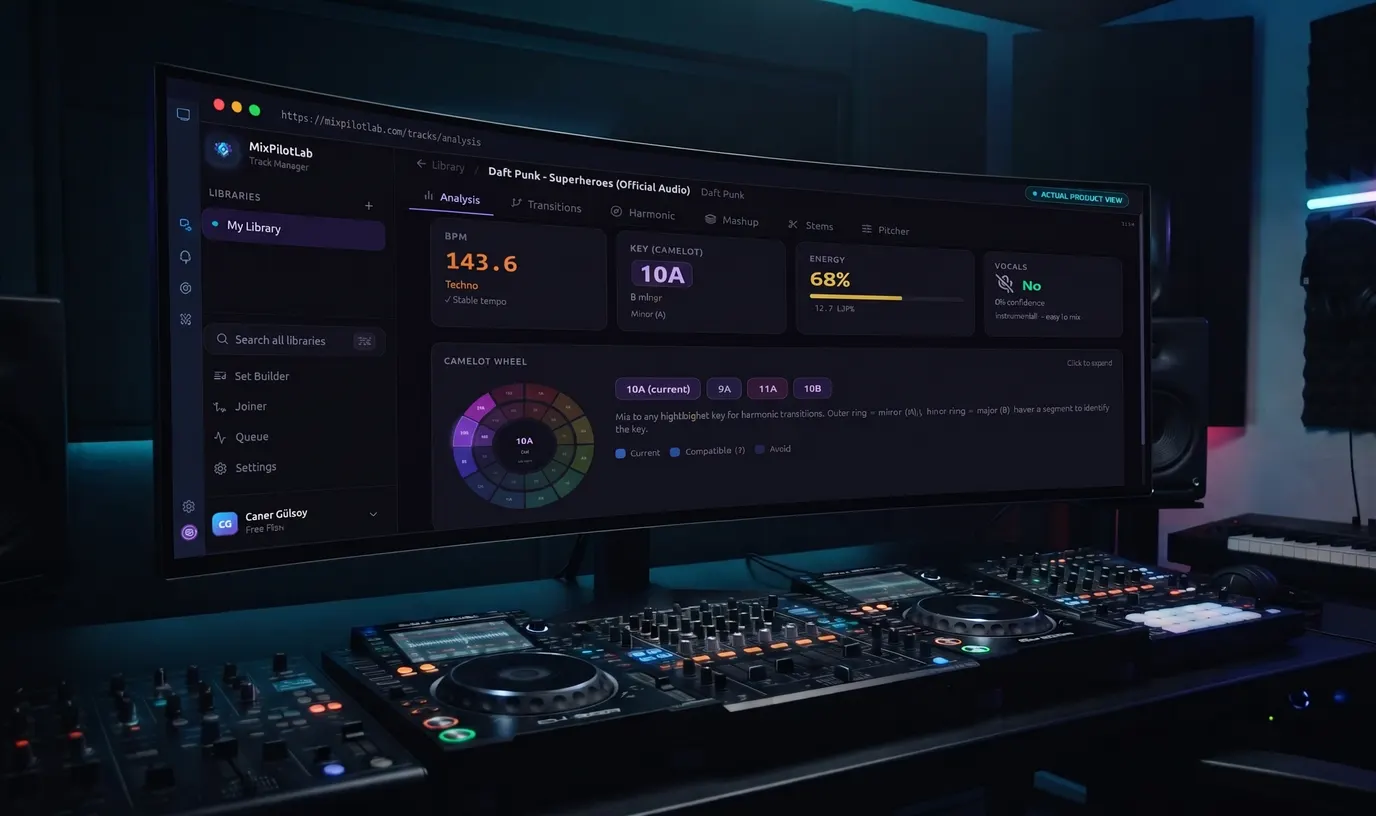
MixPilotLab's AI Music Analysis analyzes measurable characteristics such as tempo, key, and energy, making it easier to filter a large DJ library based on the characteristics that actually matter when building a set.
How to Structure a 90-Minute Progressive House DJ Set
A useful way to plan a 90-minute progressive house mix is to divide it into three broad acts rather than treating the entire set as one continuous climb.
Act 1: Opening and Atmosphere — First 25-30 Minutes
The opening section should not be about maximum energy.
Its job is to:
- Establish the musical atmosphere
- Introduce the sonic palette
- Let the room settle into the groove
- Create room for later progression
Lower-to-mid-energy tracks are usually more useful here.
Progressive house naturally supports long intros, outros, and gradual layering, so there is rarely a reason to rush the first transitions.
One of the most common mistakes is playing your strongest or highest-energy tracks during the first 15 minutes.
If you peak too early, the remaining hour has nowhere meaningful to go.
Act 2: The Build — Middle 30-40 Minutes
This is where most of the progression happens.
Instead of trying to increase energy after every single track, think in terms of a broader trajectory:
Low → Medium → Medium-High → High
A healthy energy curve does not have to rise monotonically.
For example:
58 → 64 → 62 → 69 → 73
can feel more natural than:
58 → 63 → 68 → 73 → 78
The small dip creates contrast and gives the next rise more impact.
This is one of the fundamental principles behind an effective DJ energy curve.
For a broader explanation of this concept, see What Is an Energy Curve in DJing?.
Act 3: Peak Time and Closing — Final 20-30 Minutes
Your highest-energy tracks generally belong somewhere in this final section.
But even the peak of a set can benefit from a brief pullback before the final push.
For example:
72 → 78 → 74 → 84 → 89
can feel more dynamic than:
72 → 80 → 86 → 90 → 90
The final shape depends on the context.
If another DJ is taking over, you may want to hand over at high energy. If you are closing the night, a longer cool-down may be more appropriate.
Why Progressive House Requires More Planning Than You Think
Progressive house transitions are often longer than those in many other electronic genres.
A transition might involve:
- 32 bars
- 64 bars
- Two minutes
- Three minutes
- Or even longer blends
That long-form approach is part of the genre's appeal.
It also makes a bad track decision more expensive.
Imagine blending two tracks for four minutes. If the incoming track is significantly less energetic than you expected, you have effectively spent four minutes weakening the set's momentum.
This is why a progressive house DJ should ask more than:
"Do I like this track?"
The better question is:
"What does this track do to the set at this exact moment?"
Why BPM Alone Is Not Enough for Progressive House
Progressive house often operates within a relatively narrow BPM range.
That makes one principle particularly important:
BPM ≠ Energy
Two tracks at 122 BPM can occupy completely different positions in a DJ set.
Energy analysis becomes useful because it gives you another dimension for filtering tracks.
Instead of searching your library for:
"What works around 122 BPM?"
you can search for:
"What works around 122-124 BPM, has an energy level around 65-75, and is harmonically compatible with my current track?"
That dramatically reduces the number of candidates you need to audition.
Harmonic Mixing in Progressive House
Long transitions also make harmonic compatibility particularly important.
A tonal clash lasting four seconds is one thing.
A tonal clash continuing underneath a four-minute progressive blend is something else entirely.
Basslines, pads, arpeggios, melodic synths, and vocals can remain active simultaneously for extended periods, making harmonic conflicts much easier to hear.
For that reason, Camelot Wheel and harmonic mixing are particularly useful when preparing progressive house sets.
Common starting points include:
- The same Camelot key
- ±1 Camelot move
- Appropriate relative major/minor transitions
You can learn more about the fundamentals in the Camelot Wheel & Harmonic Mixing Guide.
A Practical Progressive House Set-Building Workflow
1. Analyze your library first
Know the basic characteristics of your tracks:
- BPM
- Musical key
- Camelot code
- Energy
Instead of manually analyzing every track, use AI Music Analysis to process your library in batches.
2. Group tracks by energy
For example:
- 50-60: Opening
- 60-70: Building
- 70-80: Driving
- 80-90: Peak Time
These are not universal rules. Your own library and style should determine what the numbers mean.
3. Build the three broad sections
A useful starting structure is:
0-30 min → Opening
30-65 min → Build
65-90 min → Peak / Closing
The exact boundaries should change depending on the venue, crowd, time slot, and your musical style.
4. Check harmonic compatibility
Once the broad energy structure works, check the harmonic relationship between adjacent tracks.
A track can have exactly the right energy and still be a poor transition because the basslines or melodies clash.
5. Visualize the energy curve
When you place tracks in sequence, look for:
- Sudden energy jumps
- Long flat sections
- An unnecessarily early peak
- Drops that do not serve a purpose
MixPilotLab's Set Builder visualizes the energy curve as you arrange your tracks, making these problems easier to identify before you are in the booth.
Common Progressive House DJ Set Mistakes
Playing high-energy tracks too early
Using peak-time tracks during the opening removes room for meaningful progression later.
Relying too heavily on BPM
122 BPM does not mean two tracks have the same intensity.
Building a permanently rising energy curve
A 90-minute set that only goes upward can feel predictable and exhausting.
Ignoring harmonic compatibility
Small tonal conflicts can become increasingly obvious during long blends.
Making every transition the same length
Progressive house supports long transitions, but that does not mean every transition needs to be 64 bars.
The arrangement of the tracks should determine the appropriate transition length.
Final Takeaway: A Great Progressive House Set Tells an Energy Story
A great 90-minute progressive house DJ set is more than a collection of excellent tracks.
It should:
- Establish a starting point
- Develop energy gradually
- Create tension and release
- Maintain harmonic coherence
- Save the strongest moments for the right time
- Take the listener somewhere
The goal is not to let an algorithm choose your music.
The goal is to make BPM, key, energy, and transition compatibility visible, so you can spend your time making the decision that actually requires a DJ's judgment:
Which track feels right here?
If you are preparing a 90-minute progressive house set, use MixPilotLab Set Builder to visualize your energy curve and AI Music Analysis to analyze and filter your library faster.
Ready to put this into practice? Try MixPilotLab free — no credit card required.
Get StartedRelated reading
The Energy Curve, Explained
What a DJ set's energy curve actually is, how it's measured, and how to shape one on purpose instead of by accident.
Beatmatching by Ear vs. BPM Software: What's Actually Worth Learning
What manual beatmatching actually trains, what BPM detection actually solves, and why the two skills aren't in competition.